
BIOGRAPHY
American (1923-2012)
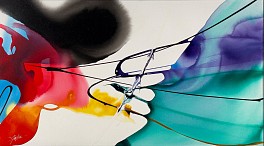
The paintings of Paul Jenkins have come to represent the spirit, vitality, and invention of post World War II American abstraction. Employing an unorthodox approach to paint application, Jenkins is as much identified with the process of controlled paint-pouring and canvas manipulation as with the gem-like veils of transparent and translucent color which have characterized his work since the late 1950s.
Born and raised in Kansas City, Missouri in 1923, he became a student of Yasuo Kuniyoshi at the Art Students League and ultimately became associated with the Abstract Expressionists, inspired in part by the "cataclysmic challenge of Pollock and the total metaphysical consumption of Mark Tobey."
Jenkins would later journey to Paris and find a second home there. He would spend much of his career journeying back and forth between Paris and New York. Indeed in 1957 Jenkins exchanged his Parisian studio with Joan Mitchell's studio on St. Mark's Place in New York. It was in Paris that he began to feel that traditional painting techniques were unable to express the spiritual and emotional experiences he was interested in capturing, so he developed his own unique style: soft, transparent waves of color that seem to float across the canvas. He titled many of his works Phenomenon—a reference to the fleeting nature of perception and memory.
An ongoing interest in Eastern religions and philosophy, the study of the I Ching, along with the writings of Carl Gustav Jung prompted Jenkins' turn toward inward reflection and mysticism which have dominated his aesthetic as well as his life.
His work can be found in museum collections around the world, including the Hirshhorn, the Met, MOMA, the Brooklyn Museum, the Guggenheim, the Whitney, the Museum of Fine Art Boston, the Baltimore Museum of Art and many others.