
BIOGRAPHY
American (1914-1985)
Writing of American Indian art, Peter Busa said: "There was a genuine love for economy of forms and unfettered simplicity of direct statement… the structure of the space reflected by American Indian art was all-positive, without negative space. This was a unique idea compared to say, cubism, which dealt with positive and negative space. They elevated primitive art to the same level of accepted art. We did for American Indian art, you might say, what Picasso did for African art."
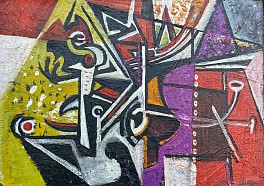
Lawrence Fine Art is pleased to present this example of Indian School painting by the American artist Peter Busa (1914-1985). Busa studied at the Art Students League with Thomas Benton in the same class as Jackson Pollock, and in 1935 he began studies with Hans Hofmann both in New York and in Provincetown. His early work was influenced by Surrealism. He would exhibit early on at Peggy Guggenheim's Art of This Century Gallery.
The decade surrounding World War II was a watershed in American art. During these years, the formative years of Abstract Expressionism, a group of artists known as the Indian Space Group participated in an intensive search to extend the language of form, sharing an aim of many others to find a human dimension within the language of abstraction.
Many American artists, looking to American roots for sources of inspiration, had already discovered in the art of Native Americans a powerful influence and counterbalance to European culture. The Indian Space artists found in Northwest Coast ideographic art the basis of a pictorial language in which image, symbol, and myth coalesced, functioning simultaneously as art form, historical narrative, and religious icon. They were thus engaged in one of the seminal issues of early abstraction: the merging of language and image. Among these artists were Steve Wheeler, Will Barnet, Robert Barrell--and Peter Busa.
Their work absorbed the influences of Klee, biomorphism through Miró, and other modernist traditions; by 1940, their paintings were emphasizing flatness and allover design. They were developing a new concept of space in which the distinction between foreground and background was eliminated, creating all-positive space.
Busa would go on to adopt a more Abstract Expressionist style. He was included in the seminal 9th Street Show in 1951.
His works are in the collections of Smithsonian Institute, Guggenheim Museum, Metropolitan Museum, the Walker Art Center, and the Whitney Museum of American Art, among others.